
By the Sunrise Packaging team · drawing on Richard Brooks's 45 years in packaging · Updated November 2026
Short answer: choose an impulse sealer if you seal polyethylene or polypropylene bags one at a time at a table, in low to medium volume. Choose a continuous band sealer when you seal a steady stream of bags, need coding or imprinting, or run thicker laminated bags. The rest of this guide explains why, and how to pick the right model.
How does an impulse sealer work?
An impulse sealer has a thin heating wire under a Teflon cover. When you press the jaw down, a short pulse of current heats the wire, melts the two layers of the bag together, and then the wire cools while the jaw is still closed. The seal sets under pressure, which gives a clean, flat seal.
Because the wire is only hot during the pulse, there is no warm-up time, very little power draw and no hot surface sitting on the table. That makes impulse sealers the most common choice for prep tables, bakeries, retail packing and small production runs.
- Hand sealers are the simplest: 4" to 20" sealing widths for most bags.
- Foot-operated sealers keep both hands free to hold and position the bag, which speeds up repetitive work. Ours come in 12", 18" and 24" widths.
- Long-arm sealers (26", 30" and 40") handle wide bags and bulk liners.
- Sealers with a trimmer cut off the excess bag as they seal, for a finished retail look.
How does a continuous band sealer work?
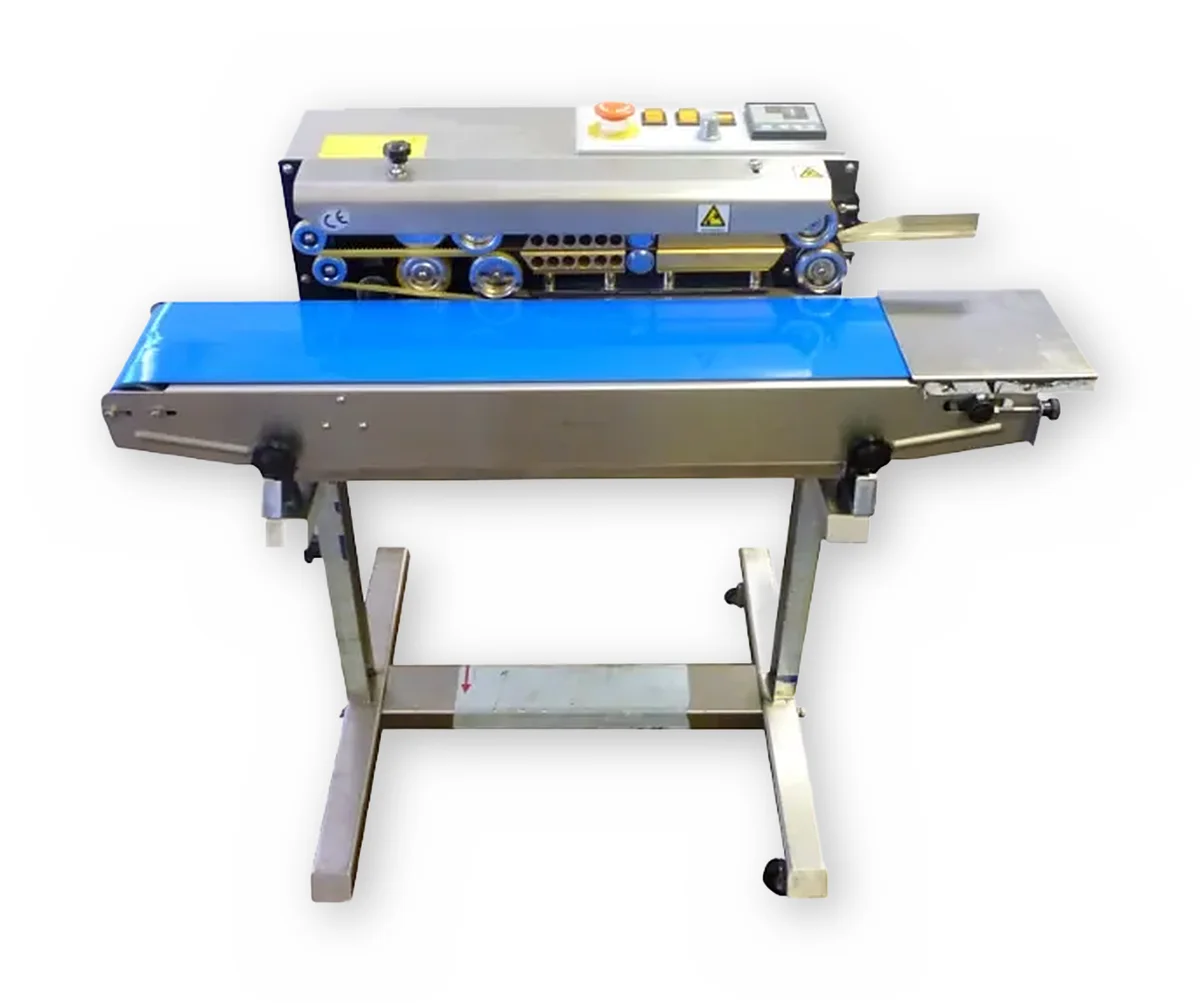
A band sealer carries the open end of the bag between two moving bands. The bag passes through a heating section, then a cooling section, and comes out sealed on the other side, without the operator stopping. Some models can also print a date or lot code into the seal as the bag passes through.
Horizontal band sealers suit bags lying on a conveyor with the opening at the top, typically small, dry items in square bags. Vertical band sealers suit upright bags. In both cases, the product must not be able to fall out as the bag moves, so liquids, round candies and loose granola are not a good match.
Impulse vs. band sealer: side by side
| What matters | Impulse sealer | Continuous band sealer |
|---|---|---|
| Volume | One bag at a time; low to medium volume | Steady stream of bags; medium to high volume |
| Bag materials | Polyethylene and polypropylene | Polyethylene, polypropylene and many laminated bags |
| Warm-up | None: instant heat | Needs to reach temperature before running |
| Coding and imprinting | No | Available on some models |
| Trimming excess bag | Yes, on trimmer models | No trimming device |
| Best products | Almost anything you can hold flat at the table | Small, dry items in square bags that cannot fall out |
| Footprint and cost | Small and economical | Larger investment; a production-line machine |
Five questions to ask before you buy a bag sealer
1. What is the bag made of, and how thick is it?
This decides more than anything else. Thin PE and PP bags seal beautifully on an impulse sealer. Thick, coated, laminated or foil bags usually need sustained heat. If you are unsure what your bag is, send us one: we test it on the actual machine.
2. How many bags do you seal in a day, and how fast must they go?
If one person seals a few hundred bags a day, an impulse hand or foot sealer is plenty. When sealing becomes the step that holds up the line, a band sealer keeps pace with filling.
3. How wide is the bag opening?
Choose a seal width a little wider than your widest bag. Wide liners and bulk bags call for a long-arm sealer.
4. Do you need a date or lot code on the seal?
Coding and imprinting are available on some band sealer models. If traceability matters, that points you to a band sealer.
5. What is in the bag?
Liquids, round items and loose products that can spill as the bag moves are a poor match for a band sealer. Impulse sealers handle them, because the operator holds the bag the whole time.
When to move from impulse to band sealing
Most of our customers start with impulse sealers. The signs it is time to upgrade are simple: people waiting at the sealer, a second sealer added just to keep up, or a new customer who wants coded bags. A band sealer keeps the same bags but removes the stop-and-start.
And if the slow part is filling the bags rather than sealing them, look at a bagging system first. That is the problem Richard Brooks solved with Bag-It-Faster™.
See it on your own bags
We match the sealer to the bag, not the other way round. Bring or send us your bag and product and we will run them on the machines, with free demos and trials. See our bag sealers or ask for a demo.